Real answers about medicine and research, from someone still on the path.
A six-month live program for high school students curious about becoming a doctor, a scientist, or both. Twelve biweekly Zoom sessions with Lutfi Huq, a medical student and PhD researcher who has been accepted to MD, PhD, and MD/PhD programs.
The people who know this path best have the least time to explain it.
High school students rarely get to sit down with someone actively training in medicine or research. As doctors and scientists move through their careers, time becomes their scarcest resource. Finding a resident or physician who will spend hours, over months, answering honest questions is close to impossible.
This program is that time. Six months of current, firsthand guidance in plain language, with room to ask anything, from what anatomy lab is really like to how to email a professor about research.
Three doors into medicine and science. Accepted through all three.
MD, PhD, and combined MD/PhD programs each look for something different. Most advisors know one path. Your student learns from someone who has been evaluated, and accepted, by all three.
Looks for very strong premed students: grades, the MCAT, clinical experience, and a clear commitment to caring for patients.
Accepted · University of MiamiLooks for very strong researchers: real lab experience, scientific curiosity, and the ability to drive a project forward.
Accepted · University of PennsylvaniaLooks for researchers whose work points toward patients, and who also want to treat them.
Accepted · RWJMS/Rutgers/Princeton MSTPHow it works
Live on Zoom, every other week
Twelve focused sessions over six months, each on one part of the path into medicine or research.
Ask anything
Raise a hand live, or send questions ahead of time. Every session ends with open Q&A.
Every session recorded
Miss one, or want to rewatch? Recordings are shared with every enrolled family.
Parents included
Parents can join any session and watch every recording, plus two sessions made just for them.
Fourteen sessions. The questions students actually have.
Medicine
Research
Your path
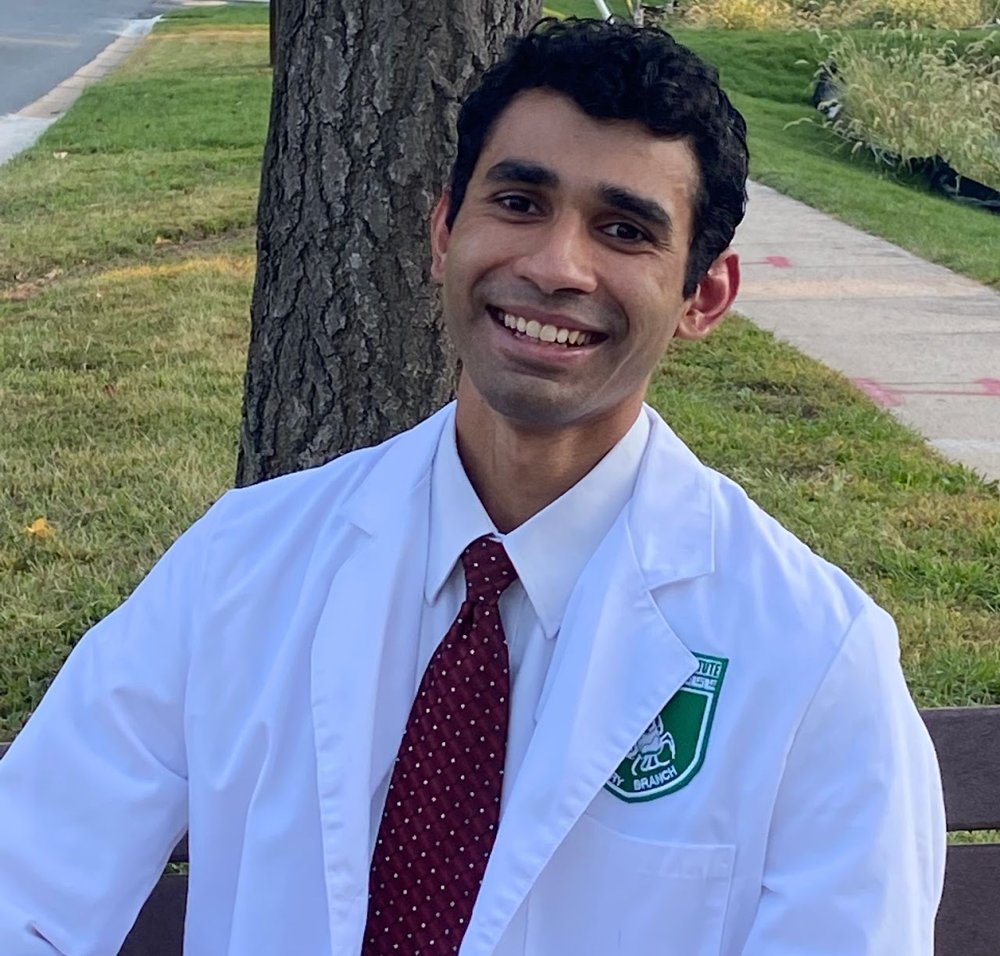
When I was at Phillips Exeter, I didn't know what an MD or a PhD was. My introduction to science came from a single lunch.
An Exeter alumnus, a physician-scientist who ran a lab at Stanford School of Medicine, came back to teach high school students about research. Over lunch, he walked us through a scientific paper, section by section. By the end, I understood what a research article was and what it takes to write one. That lunch led to two summers of research at Stanford and my first publication.
Later, I realized how lucky I was. Most students never have an alumnus who comes back to explain how science works. Without that, how would they find their way in?
In college, a summer at Mayo Clinic showed me that medicine and research can go hand in hand. After Cornell, I worked alongside two bariatric surgeons, taking histories, presenting patients, and writing notes all day. The learning curve was steep, because no one had ever shown me how a medical visit works. Now, having finished my core clerkships, I've seen what doctors in every major specialty really do.
Teaching has always been part of me, from making biology videos in high school to three years as a teaching assistant at Cornell. This program is my way of being for your student what that alumnus was for me.
Research experience your student can learn from
Published in Nature Immunology, Science Translational Medicine, the Journal of Clinical Oncology, and G3: Genes, Genomes, Genetics, with work spanning cancer immunotherapy, immunology, and the gut microbiome.




You know how competitive this path has become.
Medicine and research are more competitive than ever, and the advice most families find online is years out of date. This program gives your student recent, firsthand insight from someone going through it right now.
You're welcome at every session, and every recording is yours to watch. Two sessions are built just for parents: one on the path to medicine, one on the path to research, so you can support your student with confidence.
- 12 live biweekly sessions on Zoom
- 2 parent sessions: medicine and research
- Live Q&A in every session, plus questions in advance
- Recordings of every session for the whole family
- Templates: cold email to a professor, activity planner, and a personal roadmap
Questions families ask
Who is this program for?+
High school students in grades 9 through 12 with any interest in medicine, science, or both, even if it's only a faint one. College students considering these paths will find it valuable too.
My student isn't sure between medicine and research. Is that okay?+
That's exactly who this is for. The program covers medicine, research, and the combined MD/PhD path side by side, so students can figure out which fits them before committing years to one.
Is this one-on-one coaching?+
No. Sessions are live group webinars. Students can ask questions live or submit them in advance, and Lutfi answers them during the session.
What if my student misses a session?+
Every session is recorded and shared with enrolled families, so nothing is missed. Questions can still be sent in ahead of the next session.
Can parents attend?+
Yes. Parents are welcome at every session at no extra cost, and there are two sessions designed specifically for parents.
What does my student need?+
Just a device with Zoom and curiosity. No prior science background or research experience is required.